Raising Citizens: How Fathers Are Turning Dinner Conversations Into Civic Education
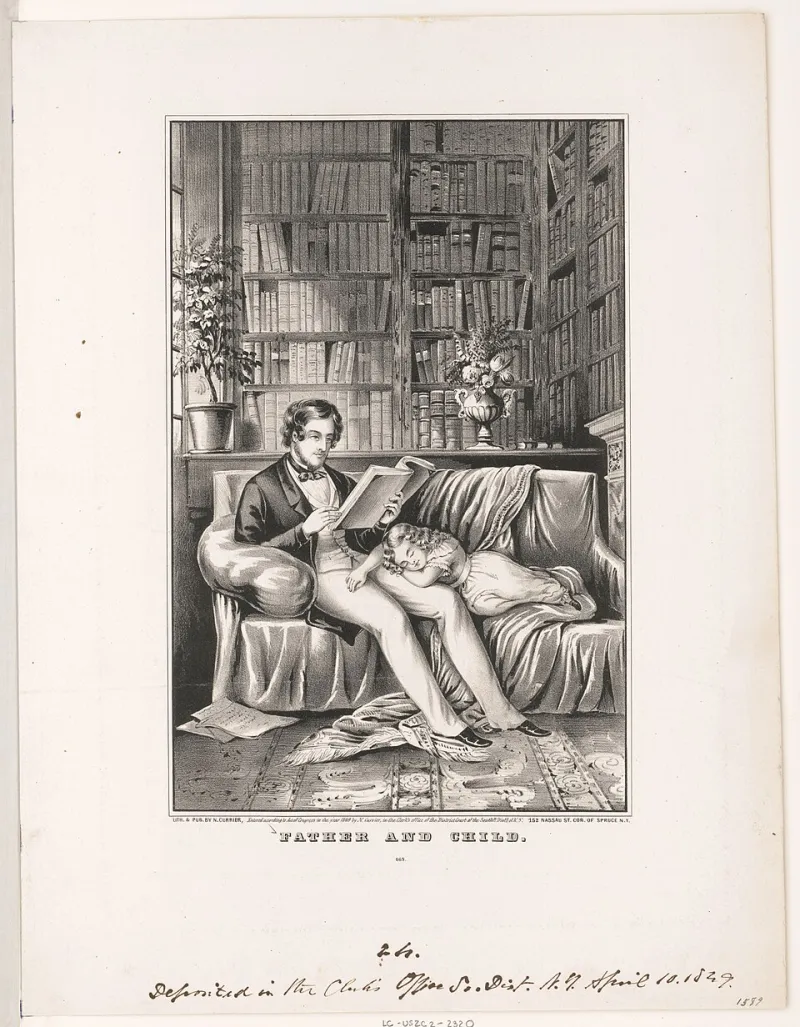
Photo: Popular Graphic Arts, Public domain, via Wikimedia Commons
There is a classroom in almost every American home that requires no curriculum, no certification, and no school board approval. It is the breakfast table. It is the drive to soccer practice. It is the moment a child looks up from a bowl of cereal and asks, "Dad, what's a senator?"
For generations, civic education has been understood as something that happens in schools — a unit on the Constitution here, a mock election there. But a growing number of fathers across the United States are recognizing that the most durable lessons in democratic participation are not delivered by textbooks. They are absorbed at home, through the way a parent engages with the world, through the questions a father chooses to answer honestly rather than deflect, and through the habits of attention and inquiry that are modeled — or not — every single day.
At Join 1 Million Men, we believe that civic engagement begins long before a man casts his first ballot or attends his first city council meeting. It begins in the formation of character, and fathers are uniquely positioned to be architects of that formation.
The Quiet Abdication — and the Case for Reclaiming It
For much of the past several decades, a subtle cultural shift has taken place. The role of civic educator within the family has been gradually ceded — to schools, to social media algorithms, to cable news, and to the ambient noise of an information-saturated culture. Many fathers, overwhelmed by the pace of modern life or uncertain how to navigate increasingly polarized political terrain, have stepped back from direct engagement with their children on matters of governance, policy, and democratic responsibility.
The consequences are measurable. Surveys consistently show that younger Americans report lower levels of civic knowledge and engagement than their predecessors. Yet research also demonstrates that children who regularly discuss current events and political topics with a parent are significantly more likely to vote, volunteer, and participate in their communities as adults.
The variable is not the school. It is the home. And in the home, fathers carry extraordinary influence.
What Civic Education at the Kitchen Table Actually Looks Like
The most effective fathers in this space are not delivering lectures. They are not assigning readings or quizzing their children on the Bill of Rights. What they are doing is far more organic — and far more powerful.
They ask questions instead of issuing opinions. A father who says, "Here is what I think about this policy," teaches his child what to think. A father who says, "What do you think would happen if the city built a new park in our neighborhood — who would benefit, who might not?" teaches his child how to think. The distinction is foundational.
They use local news as a gateway. National politics can feel abstract and distant to a ten-year-old. But a proposed school rezoning, a new stoplight on the main road, or a vote by the town council on a community center renovation — these are tangible. They are close. They invite genuine curiosity. Fathers who connect civic processes to the immediate physical world their children inhabit are making democracy real rather than theoretical.
They model civic participation visibly. Children notice what their fathers do. A father who takes his child with him to vote, who explains why he is attending a neighborhood association meeting, or who reads a local ballot measure aloud at the table is demonstrating that citizenship is an active practice, not a passive identity.
They tolerate disagreement. Perhaps most importantly, fathers who create space for their children to hold different views — who engage with those views seriously rather than dismissing them — are teaching one of democracy's most essential skills: the capacity to reason across difference.
The Ripple Effect Beyond the Household
When fathers take their role as civic educators seriously, the effects rarely remain contained within the four walls of a single home.
Children who are civically literate tend to draw their peers into civic conversations. Families that discuss current events regularly often find themselves more connected to their broader communities — attending public meetings, engaging with neighbors, and participating in local organizations at higher rates. The household becomes, in a very real sense, a node in a larger civic network.
This is not an abstraction. In communities across the country — from rural counties in Appalachia to suburban neighborhoods outside Atlanta, from small towns on the Great Plains to mid-sized cities in the Pacific Northwest — men who have made civic conversation a deliberate part of family life report tangible changes in how their families relate to their communities. Their children ask questions at school board meetings. Their teenagers register to vote on their eighteenth birthdays without being reminded. Their families show up.
Practical Starting Points for Fathers Ready to Engage
For fathers who recognize the opportunity but are uncertain where to begin, the barriers are lower than they might appear.
-
Start with what is local and visible. A construction project, a local election, a change at a public school — these are accessible entry points that do not require deep political knowledge to discuss meaningfully.
-
Subscribe to a local newspaper or news outlet together. Even reading headlines aloud over breakfast normalizes the habit of paying attention to civic affairs.
-
Attend a public meeting as a family. City council sessions, school board meetings, and town halls are open to the public and rarely intimidating. Bringing a child into that room — even once — can be formative.
-
Acknowledge what you do not know. A father who says, "I'm not sure how that works — let's find out," models intellectual honesty and demonstrates that civic learning is a lifelong process, not a closed body of knowledge.
-
Connect civic issues to values your family already holds. Whether a family values fairness, community, self-reliance, faith, or environmental stewardship, there are civic conversations that flow naturally from those values. Begin there.
The Movement Starts at Home
Join 1 Million Men is built on a conviction that men, acting with intention and solidarity, can reshape the civic life of this nation. Much of that work happens in public — in town halls, in volunteer organizations, in ballot boxes. But some of the most consequential work happens in private, around a table, in the unhurried space between a father and a child.
The civic leaders this country needs twenty years from now are sitting in American homes today, waiting to be taught that their voice matters, that the systems around them are comprehensible, and that participation is not optional — it is the price of a functioning democracy.
Fathers are not the only ones who can teach those lessons. But they may be among the most powerful teachers available. The question is whether they will claim that role — or leave it to chance.