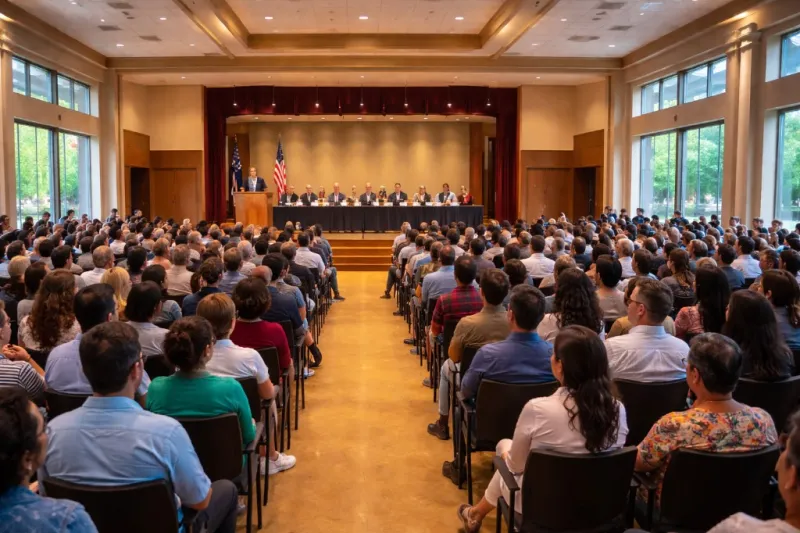
From Isolation to Involvement: How Civic Life Is Curing America's Male Loneliness Epidemic

Photo: Ganesh Mohan T, CC BY-SA 4.0, via Wikimedia Commons
A Crisis Hidden in Plain Sight
The statistics are stark, and they demand attention. According to a 2023 report from the U.S. Surgeon General, roughly half of American adults report measurable levels of loneliness—and men, particularly those between the ages of 30 and 65, are disproportionately affected. Unlike the loneliness of old age, which society has long acknowledged, this variety is quieter, more socially invisible, and far more dangerous than most people recognize.
Loneliness among men is not simply a matter of having fewer friends. Researchers at Harvard's Making Caring Common project found that men are significantly less likely than women to seek new social connections after major life transitions—divorce, relocation, job loss, retirement—leaving them stranded in a kind of invisible social exile. The health consequences rival those of smoking fifteen cigarettes a day. The civic consequences are equally severe.
When men retreat inward, communities lose something irreplaceable. Volunteer rolls thin. Neighborhood associations lose quorum. Local fire departments post desperate recruitment notices. School boards go uncontested. The withdrawal of men from public life is not merely a personal tragedy—it is a structural one, felt in every zip code across the United States.
The Civic Connection That Research Keeps Confirming
What is perhaps most striking about the emerging body of research on male loneliness is how consistently it points toward one remedy: structured, purposeful community involvement.
A landmark study published in the American Journal of Preventive Medicine found that men who regularly participated in civic activities—volunteering, attending public meetings, joining service organizations—reported significantly lower rates of depression and social isolation than those who did not, even after controlling for income, marital status, and physical health. The mechanism is not mysterious. Civic engagement provides what isolated men most lack: a reason to show up, a role that matters, and people who notice when they are absent.
Dr. Richard Weissbourd, a developmental psychologist at Harvard, has written extensively about the way men form friendships differently than women. While women tend to build bonds through direct conversation and emotional disclosure, men more often connect through shared activity and shared purpose. A pickup basketball game. A work crew. A mission. Civic life, at its best, supplies exactly that kind of purposeful, shoulder-to-shoulder engagement that allows men to build genuine relationships without requiring them to navigate the social scripts they often find uncomfortable.
What Civic Involvement Actually Looks Like
It is worth being specific, because "civic engagement" can sound abstract. In practice, it looks like Marcus, a 44-year-old electrician from Columbus, Ohio, who joined his local volunteer fire department after a decade of what he describes as "going through the motions." Within a year, he had a crew of men he trusted with his life—and who trusted him with theirs. He did not set out to cure his loneliness. He set out to do something useful. The belonging followed.
It looks like a group of fathers in suburban Atlanta who began attending school board meetings together after their children's elementary school faced budget cuts. What started as a single-issue concern evolved into a standing monthly gathering, a text thread, and eventually a neighborhood improvement coalition that has since secured crosswalk upgrades and a new youth recreation program. None of them would describe themselves as activists. They would describe themselves as neighbors who showed up.
It looks like the men who fill the seats of local planning commissions in rural Nebraska, who organize food drives through their American Legion posts in western Pennsylvania, and who coach youth athletics in communities from Tucson to Trenton—not for recognition, but because the activity gives their weeks a shape and their lives a stake in something larger than themselves.
The Structural Barriers Men Must Overcome
Acknowledging the remedy does not mean ignoring the obstacles. Men who wish to engage civically face real structural challenges that deserve honest examination.
Work schedules remain a significant barrier, particularly for men in hourly or shift-based employment who cannot easily attend evening meetings or weekend volunteer events. Cultural messaging that frames civic participation as either a professional networking exercise or a sign of political ambition keeps many men from exploring its more modest, community-rooted forms. And the simple fact of not knowing where to begin—not having a father or mentor who modeled civic involvement—leaves many men without a map.
These barriers are surmountable, but only if communities and organizations design their civic infrastructure with men's actual lives in mind. Volunteer fire departments that offer flexible training schedules, neighborhood associations that hold brief, action-oriented meetings rather than marathon deliberations, and mentorship networks that recruit through trusted male spaces—barbershops, gyms, faith communities, union halls—are already demonstrating what is possible when the invitation is made accessible.
Reframing Civic Life as a Health Practice
One of the most important shifts in how we talk about male civic engagement is treating it not as sacrifice, but as sustenance.
For too long, the dominant cultural framing has positioned community involvement as something men owe society—a debt to be paid, a duty to be discharged. That framing, however noble in intention, fails to speak to men who are already depleted, already disconnected, already uncertain of their place and purpose. It asks for a withdrawal from an account that many men feel is already overdrawn.
A more honest and more effective framing acknowledges what the research confirms: civic participation gives back more than it takes. It provides structure, identity, camaraderie, and a sense of consequence. It answers the question—one that haunts far too many American men in silence—of whether one's presence in the world actually matters.
At Join 1 Million Men, we have heard this truth reflected in the voices of men across the country who describe their entry into civic life as a turning point. Not a sacrifice, but a discovery. Not an obligation fulfilled, but a self recovered.
The Call to Show Up
America does not need men to be heroes. It needs them to be present.
It needs them at the zoning meeting and the volunteer orientation. It needs them coaching and mentoring and serving on the local library board. It needs them in the conversations that shape neighborhoods, and in the relationships that sustain the men having those conversations.
The loneliness crisis will not resolve itself. The civic participation gap will not close on its own. But the connection between the two offers something rare in public life: a problem and its solution occupying the same space. When men engage with their communities, they do not merely serve those communities. They save themselves.
That is not a small thing. In a nation that has spent years wondering how to reach men who have gone quiet, it may be the most important thing of all.
Join 1 Million Men is a national movement mobilizing American men around civic engagement, community action, and purposeful public life. To find opportunities in your community, visit join1millionmen.org.