The Civic Retreat: Understanding Why Men Are Withdrawing from Public Life—and What Must Change
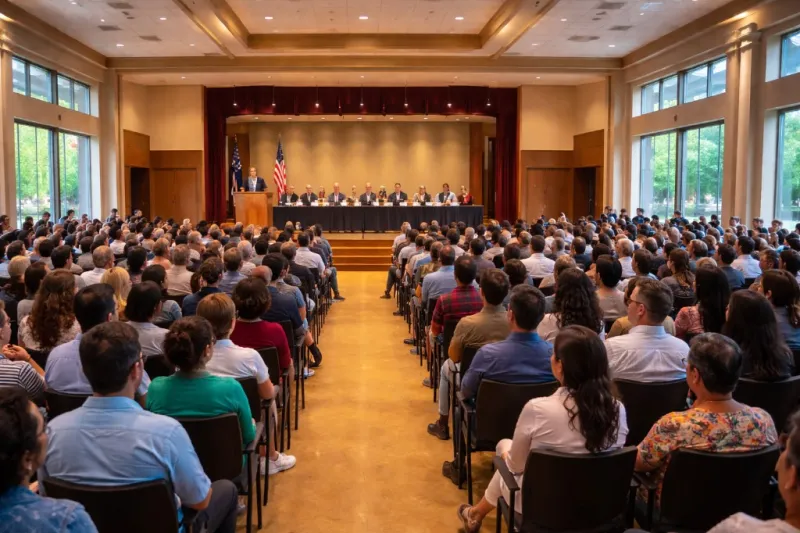
Photo: man speaking at community town hall meeting civic engagement local government, via whosaidwhat.ai
A Retreat That Rarely Makes the News
When analysts discuss declining civic participation in the United States, the conversation tends to center on voter turnout, partisan polarization, or the erosion of trust in federal institutions. What receives far less attention is a quieter and arguably more consequential trend: the steady withdrawal of men from the local civic infrastructure that governs daily American life.
School boards. Library advisory committees. Zoning commissions. Neighborhood associations. Hospital governance boards. These are the institutions that determine the quality of local schools, the character of public spaces, the allocation of community resources, and the rules by which neighborhoods evolve. And across the country, men are increasingly absent from them.
This is not an argument that men deserve preferential representation in civic spaces. It is an argument that a functional democracy requires broad and diverse participation—and that when any significant segment of the population disengages from civic life, the consequences are felt by everyone.
The Numbers Are Not Ambiguous
The data on male civic disengagement is consistent and troubling. Bureau of Labor Statistics surveys on volunteering show that men volunteer at lower rates than women across nearly every category of civic activity, a gap that has widened over the past two decades. Studies of school board composition reveal that women now hold a substantial majority of seats nationally, even in districts where the parent population is roughly balanced by gender. Participation in local government meetings, community planning processes, and neighborhood associations shows similar patterns.
Voting data adds another dimension. In the 2020 and 2022 election cycles, women voted at higher rates than men in nearly every demographic category. Among men aged 18 to 34, civic participation of nearly every measurable type has declined sharply since the early 2000s.
These trends do not exist in isolation. They correlate with other indicators of male disengagement: declining rates of workforce participation, rising rates of social isolation, and a documented decrease in organizational membership of all kinds. The civic retreat is one dimension of a broader pattern, and it demands direct examination rather than dismissal.
What Is Actually Keeping Men Away
Explaining male civic disengagement requires resisting the temptation toward simple narratives. This is not fundamentally a story about apathy, though disengagement can produce the appearance of apathy over time. Nor is it adequately explained by partisan politics, though political polarization has certainly accelerated the problem. The barriers are structural, cultural, and institutional—and they reinforce one another in ways that make the problem self-perpetuating.
Structural barriers begin with time. Men in dual-income households often carry significant work obligations that make weekday evening meetings—the standard format for most civic bodies—genuinely difficult to attend. Unlike some professional development opportunities, civic participation rarely offers career advancement, compensation, or scheduling flexibility. For men working hourly jobs or managing demanding careers, the opportunity cost of regular civic involvement is real.
Cultural barriers are subtler but perhaps more powerful. Many civic spaces—particularly those centered on education, social services, and community care—have developed cultures and communication norms that men, as latecomers to those spaces, often experience as unwelcoming or ill-suited to their preferred modes of engagement. This is not a critique of those cultures, which developed for legitimate reasons. It is an observation that unfamiliarity breeds discomfort, and discomfort breeds avoidance.
There is also the specific problem of purpose. Research on male motivation consistently finds that men engage most readily in activities where the goal is concrete, the contribution is visible, and the outcome is measurable. Many civic institutions communicate poorly about what participation actually accomplishes. Meetings that feel procedural rather than consequential—where decisions appear to have been made in advance and public input is performative—drive men away faster than almost any other factor.
Institutional barriers compound the structural and cultural ones. Many civic bodies have no formal recruitment strategy, no onboarding process, and no mentorship structure for new participants. They rely on self-selection and existing social networks to fill volunteer roles, which tends to reproduce the demographic composition of the existing membership. If men are underrepresented, this dynamic ensures they remain so.
The Cost of the Absence
When men withdraw from civic institutions, the institutions themselves are diminished—not because male perspectives are inherently superior, but because any institution that draws from a narrow pool of participants is less likely to identify the full range of community needs and less equipped to build the broad coalitions that effective governance requires.
School boards that lack fathers and male community members may miss important perspectives on how boys are experiencing the educational environment. Neighborhood associations without male participation may struggle to engage the segment of the community that is statistically most likely to be isolated and least connected to social support networks. The absence creates a feedback loop: institutions that do not reflect a community's diversity lose credibility with the segments they fail to represent, which further reduces participation.
What Organizations Must Do Differently
Reversing male civic disengagement will not happen through exhortation alone. Organizations that genuinely want to broaden participation must make structural changes.
Redesign meeting formats. Saturday morning sessions, hybrid attendance options, and time-limited commitments are all practical accommodations that lower the barrier to entry without compromising institutional effectiveness.
Communicate outcomes, not just processes. Men who are considering civic involvement need to understand specifically what their participation would accomplish. Vague appeals to civic duty are far less effective than concrete descriptions of decisions being made and problems being solved.
Create explicit recruitment pathways. Waiting for men to self-select into civic roles is a strategy for maintaining the status quo. Organizations should identify potential participants, make direct personal invitations, and provide clear information about what involvement entails.
Build mentorship into the structure. New participants in any institution benefit from guidance. Pairing new male civic participants with experienced members—regardless of gender—accelerates integration and reduces the discomfort of unfamiliarity.
Acknowledge the barriers openly. Communities and organizations that name the disengagement problem directly, rather than treating it as invisible or inevitable, create the conditions for honest problem-solving.
The Movement's Responsibility
For an organization committed to mobilizing men around civic life, the disengagement crisis is not a discouraging backdrop. It is the central challenge—and the central opportunity. One million men showing up to school board meetings, library committees, neighborhood associations, and planning commissions would not merely change the composition of those bodies. It would change what those institutions are capable of doing.
The path back to civic engagement for men runs through the same qualities that have always defined effective collective action: clear purpose, mutual accountability, tangible outcomes, and the dignity of genuine contribution. Those qualities can be built into civic institutions. The work of building them is itself an act of civic leadership.
America's local institutions are not failing because men are absent. But they are diminished by that absence. Restoring full participation is not a partisan project or a cultural statement. It is the basic democratic project—and it is one that men have both the capacity and the responsibility to rejoin.