When Men Teach Men: How Skill-Sharing Builds the Foundation of Civic Trust
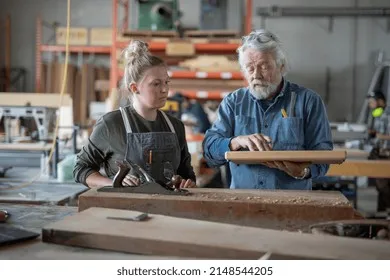
Photo: men teaching carpentry workshop community garage, via www.shutterstock.com
The Unexpected Classroom in the Garage
On a Saturday morning in Columbus, Ohio, a retired electrician named Gerald spends three hours teaching four younger men how to safely rewire an outlet. None of them are his sons. None of them are his coworkers. They are neighbors—men he met through a community swap board who showed up with questions and left with competence. By the end of the morning, they had also exchanged phone numbers, debated a proposed zoning change on their street, and agreed to attend a city council meeting together the following Tuesday.
No civic organization recruited them. No campaign mailer inspired them. A shared skill did.
This pattern—practical instruction giving rise to civic connection—is playing out in communities from Boise to Baltimore, and it deserves far more attention than it receives. When men teach each other tangible, useful things, they create something that neither political messaging nor community outreach alone can manufacture: genuine trust built on demonstrated competence and reciprocal generosity.
Competence as Social Currency
For much of American history, communities were organized around practical interdependence. Farmers helped neighbors raise barns. Mechanics kept one another's trucks running. Tradesmen passed knowledge down through apprenticeships that were as much about character formation as technical instruction. These arrangements were not merely transactional—they were the connective tissue of civic life.
That infrastructure has eroded considerably. Suburbanization, economic specialization, and the convenience economy have made it possible—and in many cases preferable—to hire out every problem rather than solve it collectively. The result is not simply a loss of skill. It is a loss of the relational networks that skill-sharing once sustained.
When a man teaches another man how to read a balance sheet, frame a wall, or negotiate a contractor's bid, he is not merely transferring information. He is entering into a relationship defined by mutual investment. The teacher demonstrates generosity; the student demonstrates trust. Both parties acknowledge a shared stake in the other's success. That dynamic, repeated across a community, accumulates into something politically significant: a population of men who know they can rely on one another.
From the Workshop to the Ward Meeting
Civic researchers have long noted that social capital—the web of relationships that enables collective action—is a stronger predictor of community health than income, education, or political ideology. What is less frequently examined is the role that skill-based relationships play in generating that capital among men specifically.
Men, on average, form friendships differently than women. Research consistently shows that male bonds tend to develop through shared activity rather than direct emotional disclosure. A man who might resist joining a discussion group will often show up readily to a tool swap, a financial literacy workshop, or a home improvement cooperative. The activity is the entry point. The relationship follows.
This matters enormously for civic mobilization. Organizations attempting to engage men through abstract appeals to duty or ideology frequently encounter resistance. The same men, invited into a practical exchange where their knowledge is valued and their time is respected, often become the most committed participants in community life. The transition from "guy who knows how to pour concrete" to "guy who shows up at the neighborhood association" is shorter than most civic strategists appreciate.
The Obligation That Grows from Gratitude
There is a moral dimension to skill-sharing that deserves direct acknowledgment. When one man teaches another something genuinely useful, the recipient carries a sense of obligation—not debt in the transactional sense, but a recognition that something was freely given and that the appropriate response is to give something in return. In many cases, that reciprocal gesture eventually extends beyond the original relationship.
Men who have benefited from informal instruction frequently describe a heightened sense of responsibility toward their community. Having been helped, they feel a pull toward helping. That impulse, when channeled deliberately, becomes the engine of civic participation. Volunteer fire departments, neighborhood watch programs, community repair shops, and local financial counseling networks all depend on exactly this kind of motivated, relationally grounded engagement.
Join 1 Million Men exists, in part, to make these pathways explicit and to encourage men to recognize the civic potential already present in their everyday exchanges. The man who spends a Saturday teaching basic plumbing to three neighbors is not just reducing their maintenance costs—he is building the social infrastructure upon which democratic communities depend.
Organizing Around What Men Already Do
The practical implication of all this is both simple and consequential: civic organizations, community leaders, and men themselves should stop waiting for ideological alignment before building civic relationships. Start with the skills.
Skill-sharing events—whether formally organized through community centers, libraries, and men's groups, or informally arranged through neighborhood networks—create the conditions for civic trust far more efficiently than most conventional engagement strategies. A Saturday workshop on basic financial literacy draws men who would never attend a political meeting. A community tool library attracts men who have no interest in joining a committee. Yet both settings generate the conversations, relationships, and shared investments that eventually translate into votes cast, meetings attended, and problems solved collectively.
Several cities have already begun to formalize this insight. Community makerspaces in cities like Detroit and Pittsburgh have evolved into genuine civic hubs, where men who arrived to learn woodworking or welding now organize neighborhood improvement projects and advocate collectively before city planning boards. The skill was the seed. The civic engagement was the harvest.
What One Million Men Can Build
The vision animating this movement is not complicated. It holds that American communities are strengthened when men are genuinely present—not as passive observers or reluctant participants, but as active contributors who invest their knowledge, their labor, and their relationships in the places where they live.
Skill-sharing is one of the most accessible and underutilized pathways to that kind of presence. It requires no particular political affiliation, no prior civic experience, and no financial resources beyond the knowledge a man already carries. It asks only that he be willing to teach what he knows and to receive what others offer.
In that exchange—in the honest transmission of something useful from one man to another—something larger than a repaired fence or a balanced ledger takes shape. A community forms. An obligation is acknowledged. A democracy is, in the most practical sense imaginable, practiced.
The toolbox has always been more than a collection of instruments. In the right hands, passed between neighbors with generosity and intent, it becomes a blueprint for the kind of civic life America still has the capacity to build.